
7 Best Places to Visit During Durga Puja Holidays in 2026
Planning a Puja holiday? Discover 7 of the best places to visit during Durga Puja holidays in 2026, from Darjeeling and Sikkim to Meghalaya and Kashmir.
 By Suman SPublished 7 October 2026 · 9 min read
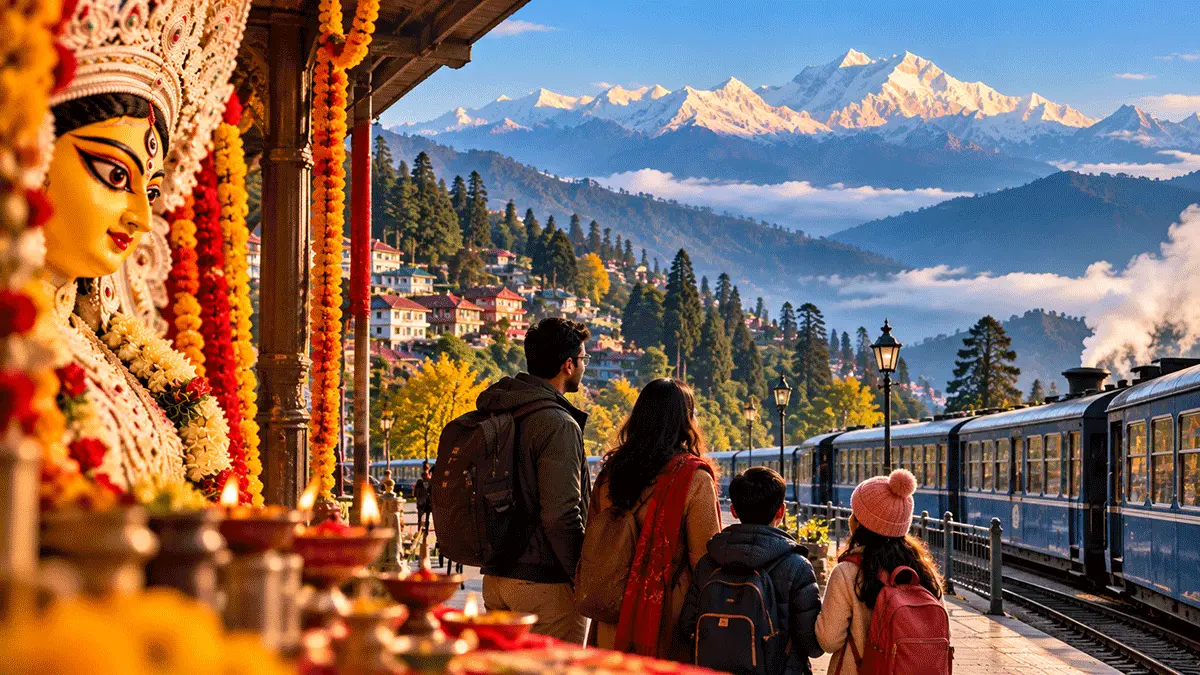
Every India Explorer story is designed to combine discovery, context and useful travel information. The article begins below.
Durga Puja is more than a festival. For millions of people, especially across eastern India, it is also that long-awaited pause in the year when offices slow down, schools close, families come together and the question inevitably arises: where should we go this Puja?
Some would never dream of leaving Kolkata while the city is glowing with pandals, lights and celebrations. Others wait for these few precious holidays to escape the crowds—to wake up among Himalayan peaks, listen to waves rolling onto a quiet beach, walk through forests or simply spend a few unhurried days somewhere new.
October is a wonderful time to travel across many parts of India. The monsoon has begun to retreat, the mountains start revealing themselves again, forests turn greener and clearer, and the oppressive heat of summer has eased across much of the country.
If you are thinking about getting away during the Puja holidays, here are seven destinations that offer seven very different ways to celebrate the break.
1. Darjeeling — When the Himalayas Return After the Monsoon
There is something particularly special about Darjeeling in autumn.
After months of rain and clouds, October brings the possibility of clearer Himalayan mornings. And when the weather cooperates, the first sight of Kanchenjunga glowing above the hills can make an early wake-up entirely worthwhile.
But Darjeeling is more than a mountain viewpoint.
Walk through Chowrasta when the evening air begins to turn cold. Watch the little shops come alive around the Mall. Sit down with a hot cup of Darjeeling tea while mist moves between the buildings. Listen for the whistle of the Darjeeling Himalayan Railway somewhere below.
Then leave the busy centre behind.
The tea gardens cascading down the slopes reveal another side of Darjeeling—quieter, greener and more closely connected to the landscape that made the town famous around the world.
What makes Darjeeling special during Puja
Autumn marks the transition from the wet monsoon months towards the clearer Himalayan season. The temperature is generally comfortable during the day and cooler after sunset.
Darjeeling is also familiar enough for a relaxed family holiday while still retaining that unmistakable feeling of having escaped to the mountains.
Don’t miss: Chowrasta, Tiger Hill, Batasia Loop, Darjeeling Himalayan Railway, tea gardens, Observatory Hill and the Himalayan Mountaineering Institute.
India Explorer tip: Puja is one of Darjeeling’s busiest travel periods. Accommodation and transport should be arranged well in advance.
2. Sikkim — Mountains, Monasteries and Roads Through the Clouds
If Darjeeling feels nostalgic, Sikkim feels expansive.
The journey itself begins to change the mood. Roads follow the Teesta, mountains rise around you, prayer flags appear beside bends, and eventually the bustle of the plains feels very far away.
Gangtok provides the comfortable introduction—cafés, markets, monasteries and mountain views—but Sikkim rewards travellers who look beyond the capital.
There are old monasteries surrounded by silence, villages tucked into green valleys, high-altitude lakes reflecting barren mountains and roads that seem to disappear into the Himalayas.
October is particularly attractive because the retreating monsoon can bring clearer mountain views and pleasant conditions at lower elevations.
What to experience
Spend time around Gangtok rather than treating it merely as a base. Visit monasteries. Explore local food. Watch the evening crowd along MG Marg.
Those travelling towards higher elevations can experience a dramatically different landscape around Tsomgo Lake and other permitted areas.
And Sikkim doesn’t always have to mean rushing north. West and South Sikkim offer quieter alternatives for travellers who would rather exchange sightseeing checklists for villages, monasteries and mountain views.
Don’t miss: Gangtok, Rumtek Monastery, Tsomgo Lake, Namchi, Pelling and Ravangla.
India Explorer tip: Some high-altitude areas require permits, and access can change depending on weather and road conditions. Check current requirements before travelling.
3. Dooars — A Puja Holiday Among Forests and Rivers
Not every Puja holiday needs crowded viewpoints and famous landmarks.
Sometimes the best escape is a road disappearing between forests.
The Dooars, stretching across the Himalayan foothills of northern West Bengal, offers exactly that kind of holiday. Tea gardens spread across the landscape, rivers descend from Bhutan, forests surround small settlements and the mountains remain tantalisingly close.
The pace is different here.
Morning may begin with birds outside a forest lodge rather than traffic outside a hotel. The afternoon could mean driving through tea country, sitting beside a river or exploring one of the small settlements scattered across the region.
Wildlife is certainly part of the attraction, but Dooars shouldn’t be viewed only through the promise of spotting an elephant or rhinoceros. The landscape itself is the experience.
Why choose Dooars during Puja?
For travellers from West Bengal, it offers a combination that is difficult to resist: nature, relatively easy access, forests, tea gardens and the foothills of the Himalayas.
Families can enjoy it, but so can travellers who simply want several slow days away from city life.
Look out for: Jaldapara, Murti, Lataguri, Samsing, Suntalekhola, Buxa and the tea-growing landscapes around the region.
India Explorer tip: Wildlife-zone access is regulated and can vary seasonally. Verify current forest opening dates and safari availability rather than planning a trip solely around a safari.
4. Puri — Where the Festival Holiday Meets the Sea
For generations of Bengali families, few holiday destinations have been as familiar as Puri.
And familiarity hasn’t diminished its appeal.
There is still something satisfying about waking before sunrise and walking towards the beach while the town is only beginning to stir. Fishing boats appear as silhouettes against the horizon. Tea stalls open. The first light spreads across the Bay of Bengal.
By evening, the beach has transformed completely—families, vendors, food stalls and the constant sound of waves.
At the spiritual heart of the city stands Sri Jagannath Temple, giving Puri an identity that goes far beyond its coastline.
Look beyond the main beach
A Puja holiday in Puri can also open the door to a wider exploration of Odisha.
Konark’s Sun Temple brings extraordinary architecture and history into the journey. Chilika introduces an entirely different landscape of water and wetlands. Smaller stretches of coastline reveal a quieter Odisha away from Puri’s crowds.
Don’t miss: Jagannath Temple, Puri Beach, Konark Sun Temple and Chilika Lake.
India Explorer tip: Puja holidays can bring very heavy crowds. If peaceful beaches are the priority, explore the wider Odisha coast instead of spending every day around Puri’s busiest beachfront.
5. Meghalaya — Follow the Water Into the Hills
Meghalaya doesn’t reveal itself through one famous monument.
It unfolds through landscapes.
A road bends and suddenly opens onto an enormous green valley. A waterfall drops from a cliff. Clouds drift across the road. A village appears among hills. Somewhere below, a river cuts through rock so clearly that boats seem to float in the air.
Shillong is usually the gateway, but the real magic begins as you travel deeper into the Khasi Hills.
Around Sohra, rain has sculpted cliffs, caves and waterfalls over thousands of years. Elsewhere, living root bridges demonstrate something even more remarkable: a relationship between people and nature developed patiently across generations.
Then there is Dawki and the Umngot River, whose appearance changes with season, rainfall and water conditions.
Why Puja can be a fascinating time
The monsoon has only recently begun withdrawing from this part of India, meaning the landscape can remain intensely green and waterfalls may still carry substantial water.
Weather, however, is part of Meghalaya’s personality. Clouds and rain don’t always follow a traveller’s plans.
Experience: Shillong, Sohra (Cherrapunji), living root bridges, waterfalls, Khasi villages, Mawlynnong and the Dawki region.
India Explorer tip: Don’t judge Meghalaya only by viral photographs of crystal-clear water. Conditions are seasonal. Go for the entire landscape and culture, not one photograph.
6. Varanasi — A Journey Into India’s Living Past
Not every holiday needs to be an escape into nature.
Some journeys are about stepping into a place so intense that it demands your attention.
Varanasi is one of them.
Before sunrise, boats begin moving across the Ganga while the ghats slowly emerge from darkness. Bells ring somewhere inside the old city. People descend the steps to bathe. Priests prepare for morning rituals. Tea simmers in tiny shops.
A few hours later, the lanes are alive with an entirely different energy.
Varanasi can be noisy, crowded, confusing and deeply moving—sometimes all within the same few minutes.
Experience the city slowly
The temptation is to reduce Varanasi to the evening Ganga Aarti. Don’t.
Walk along the ghats in the morning. Enter the old lanes without rushing. Sit beside the river. Try a simple kachori breakfast. Watch craftspeople at work. Visit Sarnath and encounter another chapter of India’s spiritual history.
Varanasi rewards observation.
Experience: the ghats at sunrise, old-city lanes, Ganga Aarti, local food, Banarasi weaving traditions and Sarnath.
India Explorer tip: Varanasi is best approached with patience. Allow yourself time to observe rather than trying to “cover” the city.
7. Kashmir — Autumn in the Valley
By October, Kashmir begins changing colour.
The deep greens of summer slowly give way to warmer shades. Chinar leaves turn red and gold. Mornings become colder. The light over Dal Lake changes. Beyond Srinagar, mountain valleys begin preparing for winter.
For travellers with enough time for a longer Puja break, Kashmir offers an experience entirely different from the other destinations on this list.
Srinagar itself deserves time.
A quiet shikara ride early in the morning feels very different from one taken amid the day’s activity. Mughal gardens tell stories of another era. Markets reveal everyday Kashmir through spices, dry fruits, handicrafts and conversations.
Beyond the city lie landscapes that have made Kashmir synonymous with mountain beauty—Pahalgam’s valleys, Gulmarg’s meadows and the dramatic road towards Sonamarg.
Why visit in autumn?
Autumn gives Kashmir its own visual identity. It is neither the snow-covered Kashmir of winter nor the flower-filled landscape associated with spring.
It is quieter in colour, richer in atmosphere and particularly beautiful when the chinar trees begin their transformation.
Experience: Srinagar, Dal Lake, Mughal gardens, Pahalgam, Gulmarg, local markets, Kashmiri cuisine and autumn landscapes.
India Explorer tip: Conditions in mountain areas can change quickly. Check current road, weather and local travel advisories shortly before departure.
Seven Destinations, Seven Different Pujas
The perfect Puja holiday doesn’t mean the same thing to everyone.
For some, it is Kanchenjunga appearing above Darjeeling on a clear autumn morning. For others, it is a forest road through Dooars, waves crashing onto the shore at Puri, clouds moving through Meghalaya or chinar leaves turning golden beside a Kashmir road.
And perhaps that is what makes the Puja break so special.
You don’t necessarily need to travel farther. You need to travel somewhere that allows you to experience these few days differently.
The mountains will appeal to some. Others will choose the sea. Some will look for forests, while others will want history, food, faith or simply the pleasure of discovering a place they haven’t seen before.
Wherever you choose, travel slowly enough to notice it.
Because the places we remember aren’t always the ones where we managed to see everything.
They are usually the ones where, for a little while, we stopped rushing.

Suman S
An Indian wayfarer collecting stories beyond the map